
Tools for Change: Understanding Economic Prosperity in Iowa
When Iowa’s women and girls prosper, we all prosper. Stronger families, a more resilient workforce and thriving communities are all connected to the opportunities available to women and girls across our state.
But achieving economic prosperity isn’t as simple as earning a paycheck.
Access to affordable childcare, stable housing, education and training, employment opportunities, reliable transportation and mentorship all play important roles in a woman’s ability to build financial security and independence.
And these challenges rarely exist in isolation. They often overlap, creating obstacles that can be difficult to overcome without broader support.
Understanding these challenges is an important first step toward creating lasting change. But what we do with that understanding matters just as much.
We’ve created this resource to help you explore the facts, start meaningful conversations and discover ways to help build a more prosperous Iowa.
Learn to Look Beyond the Numbers
Behind every statistic are hundreds or thousands of lived experiences and stories. And while no single data point can capture the full experience of every woman and girl in Iowa, it can help us better understand where change is needed.
Consider these facts about economic prosperity in Iowa:
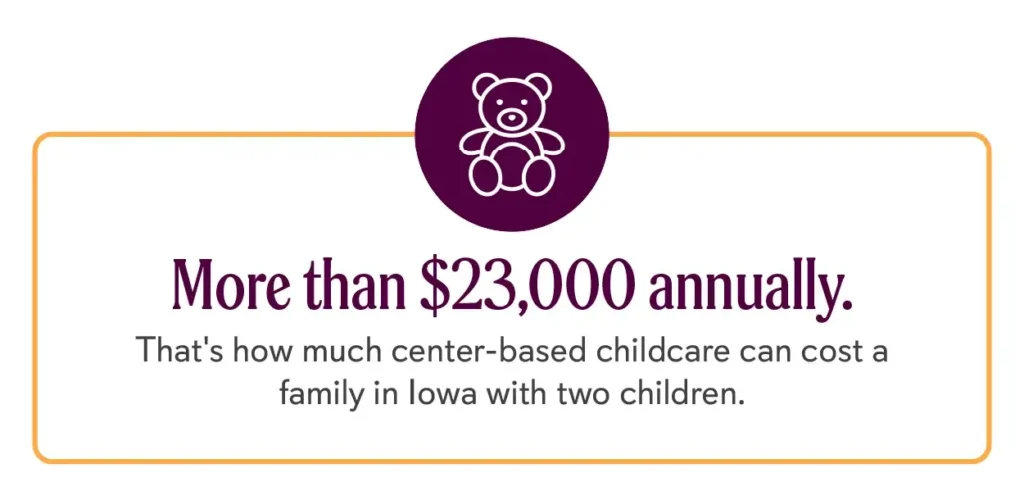
More Than $23,000 Annually
For a family with two children, Iowa center-based childcare can cost more than $23,000 per year.
For many families, that’s a substantial portion of their household income. High childcare costs can make it difficult for parents, particularly women, to remain in the workforce, pursue additional education or advance in their careers.
Source: Child Care Aware of America — 2024 Affordability Analysis
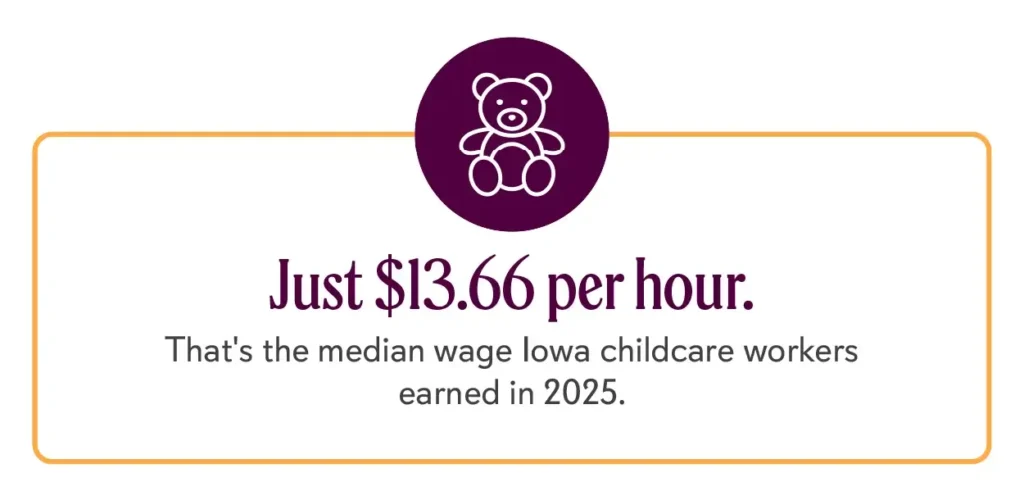
Just $13.66 Per Hour
The median wage for Iowa childcare workers was just $13.66 per hour in 2025, or approximately $28,420 annually.
These workers, predominantly women, provide an essential service that makes employment possible for countless other Iowans.
Source: CareerOneStop/Bureau of Labor Statistics — Iowa Childcare Worker Wages
Approximately 110 Hours Per Week
An Iowa worker earning minimum wage would need to work approximately 110 hours per week to afford a two-bedroom rental home at Fair Market Rent.
This illustrates just how difficult it can be to achieve stable housing and financial security when wages don’t keep pace with essential living expenses.
Source: National Low Income Housing Coalition — Out of Reach 2025
81¢ for Every $1 Earned
Iowa women working full-time earn about 81 cents for every dollar earned by men.
Over time, this wage gap can have lasting implications for women’s ability to build savings, invest in their futures and achieve financial independence.
But the gender pay gap is only part of a much larger conversation.
At IWF’s 2026 Annual Luncheon, keynote speaker Josie Cox highlighted the broader gender equity gap. Factors such as race, geography, socioeconomic background and access to opportunity can shape economic outcomes in very different ways.
For instance, a woman living in rural Iowa may face limited access to childcare or employment opportunities, while a woman in an urban community may have more options available but struggle with the cost of housing and childcare. Both face challenges to economic prosperity, but their experiences and the support they need may look very different.
Understanding the gender equity gap means looking beyond what women earn to consider the opportunities and obstacles that influence their ability to prosper.
Source: USAFacts — Iowa Gender Pay Gap
Connecting the Dots: The Bigger Picture of Gender Equity.
The statistics we’ve explored tell an interconnected story.
A woman may work full-time but still struggle to afford childcare or stable housing.
A childcare worker may spend her days making it possible for other parents to work while facing financial insecurity herself.
And limited access to education, training or mentorship can make it harder to pursue opportunities that could improve long-term economic security.
When one barrier becomes more difficult to overcome, others can become even more challenging.
That’s why addressing economic prosperity requires us to look beyond any single issue and recognize how these challenges influence one another.
This understanding is central to IWF’s work. Through research, education, advocacy, collaboration and grantmaking, we work to address six critical barriers to economic prosperity: childcare, housing, education and training, transportation, employment and mentorship.
By addressing these interconnected challenges, we can help create more opportunities for Iowa women and girls to achieve economic security and independence.
And it’s why understanding experiences beyond our own is so important.
Carrying Understanding into Meaningful Conversations
Meaningful change often begins with a conversation.
When we share information, ask thoughtful questions and listen to different perspectives, we create opportunities to better understand the challenges facing women and girls in our communities.
These conversations don’t have to happen at a formal event or around a conference table. They can happen over coffee with a friend, around the dinner table with family, or among colleagues at work.
You don’t need to have all the answers to start a meaningful conversation. You just need to be willing to ask questions and listen.
Questions to Get the Conversation Started
At IWF’s 2026 Annual Luncheon, attendees explored two important questions. We invite you to revisit them with new perspectives and bring them into conversations of your own.
- What would economic prosperity look like for women and girls in your community?
Think beyond income alone. Consider access to opportunity, financial independence, stability and the ability to plan for the future. - What can we do together to create more opportunities for women and girls to thrive economically?
Think about the roles individuals, businesses, organizations and communities can play in removing barriers and expanding opportunities.
Take the Conversation a Step Further
As you explore these questions, consider digging a little deeper:
- Look beyond your own experiences and resources. What challenges might women and girls in your community face that you haven’t personally experienced? How would your situation change if you no longer had access to certain resources?
- Explore the connections. How might access to childcare, affordable housing or education influence someone’s employment opportunities and financial security?
- Consider what’s possible. What resources, partnerships or changes could help address these challenges in your community?
- Identify opportunities for action. What’s one thing you or your community could do to help create more economic opportunity?
Tips for Meaningful Conversations
The goal isn’t to prove someone right or wrong. It’s to build understanding and find common ground.
- Lead with curiosity. Ask questions rather than making assumptions about another person’s experiences.
- Use facts to inform, not divide. Data can help us look beyond our own experiences and better understand the bigger picture.
- Listen to different perspectives. Our experiences shape how we understand the world. Make space for viewpoints that may differ from your own.
- Look for shared goals. Even when perspectives differ, we can often find common ground in wanting stronger families, thriving communities and more opportunities for everyone.
Remember: Every perspective brings something valuable to the conversation, and every conversation creates an opportunity to learn.
Action: Turn Conversations into Change
Understanding the challenges is an important first step. But creating lasting economic change takes collaboration, commitment and investment.
At the Iowa Women’s Foundation (IWF), we work to address the barriers to economic prosperity through education, advocacy, partnerships and grantmaking.
At our 2026 Annual Luncheon, we announced $400,000 in grants to 15 organizations advancing economic prosperity for women and girls across Iowa.
These investments are one example of how IWF supports community-based efforts to remove barriers and expand opportunities.
But meaningful progress doesn’t happen through any single organization, program or solution. It happens when we work together.
What Can You Do to Help?
There are many ways to play a role in creating a more prosperous Iowa, and every action matters.
Start a conversation.
Choose one of the questions above and share it with a friend, family member or colleague. Use what you’ve learned to encourage thoughtful discussions about the barriers facing women and girls in Iowa.
Explore what’s happening in your community.
Learn more about the organizations and initiatives working to improve economic opportunities for women and girls. Consider how your time, talents or resources could support their efforts.
Share your perspective.
What does economic prosperity mean to you? What challenges do you see in your community, and what opportunities exist to create meaningful change?
We always want to hear from you! Share your answers to our conversation questions or tell us how you’ve continued the conversation in your own circles.

Support the work.
Investing in economic opportunity for women and girls benefits families, workplaces and communities across Iowa.
Discover how IWF is working to remove barriers and how you can be part of creating lasting change.